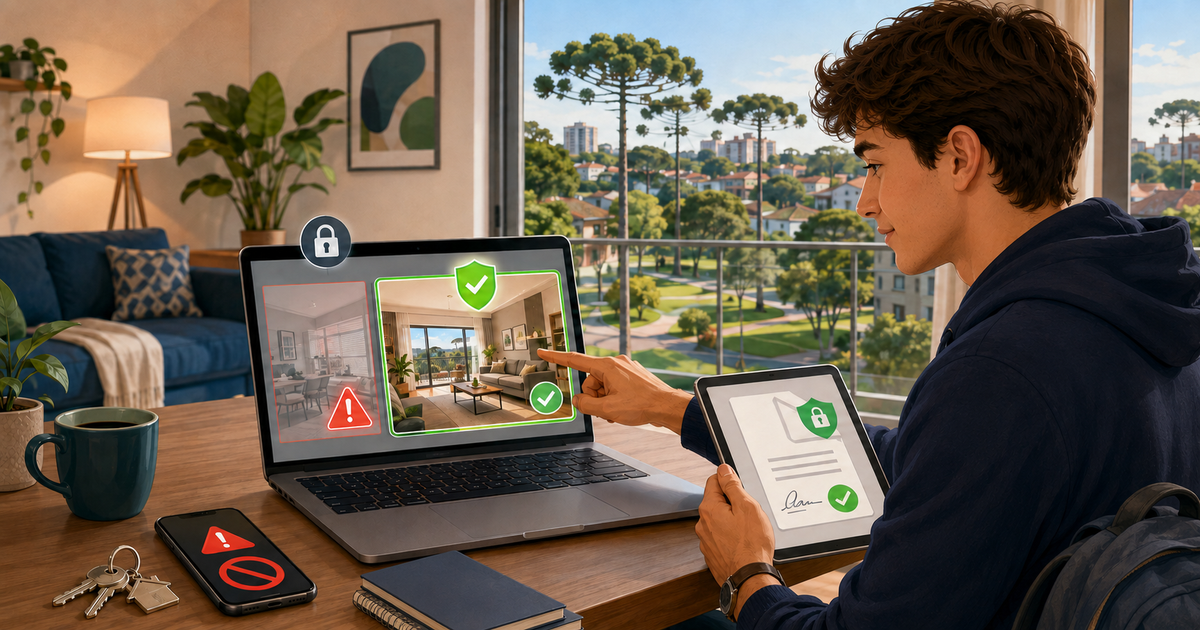
Summary
Learn how to spot rental scams in Brazil, verify properties and contracts, and protect your money before renting an apartment.
How to Avoid Rental Scams in Brazil: A Guide for Foreigners in 2026
Rental scams in Brazil often begin with an attractive listing, a believable conversation and pressure to send money before someone else takes the property.
Foreigners are particularly exposed when they are still abroad, cannot visit the apartment and are unfamiliar with Brazilian documents, payment methods and rental practices.
The safest approach is to verify the property, the advertiser, the contract and the payment recipient separately. A professional-looking listing or WhatsApp profile is not enough.
TL;DR
Before paying for a rental in Brazil:
- Compare the price with similar properties.
- Search the address and listing photos.
- Verify the company’s legal name and CNPJ.
- Check the real website and contact channels independently.
- Verify the broker’s CRECI registration when applicable.
- Confirm the advertiser’s connection to the property.
- Request a live video tour or independent inspection.
- Read the complete contract.
- Match the payment recipient with the contract.
- Never pay only to “hold” a property without written terms.
- Save the listing, messages, contract and receipts.
- Confirm access instructions before travelling.
Verdict: recommended when the company, property, contract and payment details can all be independently verified.
Sending money because the advertiser claims that another tenant is waiting is not recommended.
Why foreigners can be easier targets
A scammer may assume that a foreign tenant:
- Cannot visit the property
- Does not speak Portuguese
- Does not understand CPF, CNPJ or CRECI
- Is under pressure because of a flight, course or job start date
- Does not know the normal rental process
- Cannot easily compare local prices
- Will pay an international transfer or deposit in advance
- May have difficulty reporting a crime from abroad
A legitimate company may still request documents, advance payment or a security deposit. The warning sign is not the existence of a payment itself, but the absence of a verifiable process explaining who receives it, why it is charged and what happens if the rental does not proceed.
The most common rental scam patterns
Copied listing
A scammer copies photographs and descriptions from a legitimate website, then republishes the property using a different phone number and a lower price.
The apartment may exist, but the person collecting the payment has no authority to rent it.
Fake owner
The advertiser claims to own the apartment but refuses to demonstrate any connection to the property. They may send a photograph of an identity document, but an image of a document can also be stolen.
Fake real estate agent
The person presents themselves as a broker but provides a false, inactive or unrelated CRECI registration number.
Urgent reservation deposit
The scammer says several people are interested and requests an immediate transfer to “secure,” “hold” or “remove” the property from the market.
The payment may be described as refundable even though no written refund rules are provided.
Fake company or cloned website
The website may use a name, logo and design similar to those of a legitimate rental company. The domain, email address or payment page will be slightly different.
Changed payment details
After a legitimate-looking conversation, the advertiser sends new bank details or a different payment link, claiming that the original system is unavailable.
Nonexistent apartment
The address may be incomplete, the unit number may not exist or the building may not permit the advertised type of rental.
Multiple deposits for the same property
The scammer collects reservation deposits from several prospective tenants and disappears before the check-in date.
Warning signs before signing
Be cautious when the advertiser:
- Offers a price far below comparable properties
- Refuses a live video call
- Avoids providing the complete address
- Does not disclose the apartment number before contracting
- Says the owner is permanently unavailable
- Cannot explain their connection to the property
- Refuses to provide a contract
- Sends a contract with blank spaces
- Uses a different name in the listing, contract and payment account
- Communicates only through disappearing messages
- Refuses to use an official company email address
- Requests payment to an unrelated third party
- Pressures you to pay within minutes
- Promises guaranteed approval without reviewing documents
- Claims every expense is included but will not list them
- Changes the payment instructions shortly before the transfer
- Asks for cryptocurrency, gift cards or another difficult-to-reverse method
One warning sign does not always prove fraud. Several unexplained inconsistencies should stop the transaction until they are resolved.
Step 1 — Compare the price with the local market
An unusually low price is one of the most common ways to attract victims.
Compare the listing with apartments that have:
- Similar location
- Similar size
- The same number of bedrooms
- Comparable furniture
- Similar building facilities
- The same rental period
- The same included expenses
Make sure you are comparing the total monthly cost. One listing may include condominium fees, property tax and Internet, while another displays only the base rent.
A legitimate discount can exist, but the advertiser should be able to explain it without pressuring you to pay immediately.
Step 2 — Search the address, photographs and description
Search the complete address and key phrases from the description. You may find the same property on another website with a different price or contact person.
A reverse image search can also reveal whether the photographs were copied from:
- Another rental listing
- A property for sale
- A hotel
- An apartment in another city
- A design or architecture website
Finding the same photographs elsewhere does not automatically indicate fraud. Owners and real estate companies may advertise on several platforms. The problem is conflicting information that the advertiser cannot explain.
Step 3 — Verify the company independently
If the rental is offered by a company, request:
- Legal company name
- CNPJ
- Official website
- Company email address
- Registered address
- Customer support channel
- Contracting entity’s name
You can check a company’s registration and status using the Brazilian government’s free CNPJ consultation service.
Compare the result with the contract and payment details. Check whether:
- The company is active
- The legal name matches
- The business activity is plausible
- The address is consistent
- The payment recipient is explained
A valid CNPJ alone does not guarantee that the person contacting you represents that company. Contact the business using the phone number or website found independently, not only the details sent through WhatsApp.
Step 4 — Verify the broker when applicable
Professional real estate brokers in Brazil are registered with a regional CRECI council.
Ask for the broker’s:
- Full name
- CRECI number
- State of registration
- Real estate company name
For properties in Paraná, the CRECI-PR credential search allows you to check whether a professional is registered.
Do not rely only on a photograph of a professional card. Compare the registered name and contact information, and contact the real estate agency independently if necessary.
Not every furnished rental platform interaction involves an individual broker. The absence of a personal CRECI number does not automatically indicate fraud when you are contracting directly with a properly identified company or owner.
Step 5 — Confirm the advertiser’s connection to the property
Ask the advertiser to explain whether they are:
- The owner
- A broker
- An employee of a rental company
- A property manager
- An authorized representative
The contract should identify the parties and the basis on which the property is being offered.
If you are renting directly from an individual, consider requesting documents that reasonably demonstrate the person’s authority to rent the apartment. Avoid collecting unnecessary personal data and never assume that a photograph of an identity document proves ownership.
When appropriate, independently contact:
- The building administration
- The condominium manager
- The real estate agency
- The property management company
- A trusted person who can visit the address
The purpose is to confirm that the apartment exists and that the rental arrangement is plausible.
Step 6 — Request a live video tour
A recorded video is useful, but it may have been copied from another listing.
When you cannot visit in person, request a live call and ask the person to show:
- The building entrance
- The apartment door
- The view from the windows
- The kitchen and bathroom
- The furniture and appliances
- A detail chosen during the call
- The route from the apartment to a common area
A scammer may invent reasons why a live call is impossible. A legitimate company might also have operational restrictions, but it should provide another reliable way to verify the unit.
For a high-value or long rental, consider asking a trusted local person to visit before you pay.
Step 7 — Verify what is included
The expression “all bills included” should not be accepted without a written breakdown.
Request confirmation of:
- Monthly rent
- Condominium fees
- IPTU
- Internet
- Water
- Electricity
- Gas
- Parking
- Laundry
- Cleaning services
- Entry fee
- Security deposit
- Check-out cleaning
- Optional services
- Consumption limits
Ask whether each charge is:
- Included
- Estimated
- Billed according to use
- Subject to a limit
- Refundable
- Nonrefundable
A scammer may advertise an unrealistically low total and introduce extra charges only after receiving the first payment.
Step 8 — Read the complete contract
The contract should clearly identify:
- The parties
- The property
- The apartment number
- The rental dates
- The monthly amount
- The payment schedule
- The included expenses
- The security arrangement
- The cancellation rules
- The early termination conditions
- The inventory
- The rules for additional occupants
- The process for receiving access
Check that the names, dates and values match what was agreed.
Do not sign a contract containing:
- Blank fields
- A different property
- A different company
- An unexplained payment recipient
- Charges that were not disclosed
- Dates that do not match your stay
An electronic contract can be valid in Brazil. What matters is that you can identify the parties, preserve the document and verify the method used to demonstrate authorship and integrity.
Step 9 — Check the payment recipient
Before paying, compare:
| Information | It should match or be clearly explained |
|---|---|
| Advertiser | Person or company offering the property |
| Contracting party | Name shown in the contract |
| Payment recipient | Bank account or payment processor |
| CNPJ or CPF | Identification connected to the transaction |
| Payment description | Rent, entry fee, deposit or another charge |
| Refund rule | Written conditions applicable to the payment |
A payment to a third-party processor can be legitimate. The contract or official payment instructions should explain that relationship.
Stop and verify if:
- The account holder changes unexpectedly
- The account belongs to an unrelated individual
- The payment link uses an unfamiliar domain
- The QR code is sent from a new number
- The advertiser discourages you from contacting the company
- The requested amount differs from the contract
Step 10 — Understand each payment before sending it
Before paying, ask:
- What is this payment for?
- Is it refundable?
- When does it become nonrefundable?
- What happens if my application is rejected?
- What happens if I cancel?
- What happens if the property becomes unavailable?
- Will I receive an invoice or receipt?
- Does payment confirm the reservation?
- Are there further payments before check-in?
Shortstay, for example, explains that foreign guests may receive a credit card payment option after completing verification and signing the contract. The company then monitors the payment and confirms the reservation once it is approved. See the official explanation of how foreign guests can pay.
Using a documented process reduces uncertainty, but you should still confirm that you are on the authentic website and using the official payment link.
Step 11 — Do not confuse a request with a confirmed booking
A reservation may pass through several stages:
- Request submitted
- Documents under review
- Application approved
- Contract generated
- Contract signed
- Initial payment completed
- Payment approved
- Access authorized
Shortstay describes its process as document analysis, contract preparation, payment and key handover. Review what happens after a reservation request.
Do not travel based only on a pending request, an unsigned contract or a payment that has not been confirmed.
Step 12 — Confirm access before flying
Before travelling, obtain:
- Complete property address
- Apartment number
- Approved check-in date
- Permitted check-in time
- Key collection instructions
- Building entry procedure
- Contact for arrival problems
- Confirmation of additional occupants
- Late-arrival instructions
Access may depend on identity verification, signed documents, payment approval and condominium registration. Shortstay’s check-in and access policy explains that pending formalities may prevent entry.
A scammer may continue communicating until the arrival date and disappear only when you are standing outside the building. Written access confirmation is therefore essential.
Is paying through WhatsApp always unsafe?
No. WhatsApp is widely used in Brazil by legitimate owners, brokers and companies.
The risk comes from treating a messaging conversation as the only evidence of the transaction.
WhatsApp can be used for communication, but you should still have:
- Verified identities
- A complete contract
- Official payment instructions
- Receipts
- An address
- Written cancellation conditions
- A formal support channel
Do not trust a payment request simply because it arrives in an existing conversation. Accounts can be compromised, and criminals can impersonate employees.
If payment details change, confirm them through another official channel.
What should you do if you suspect a scam before paying?
Stop the transaction and do not send additional documents or money.
Then:
- Contact the company using an independently verified channel.
- Ask the bank account or payment details to be confirmed.
- Save the listing and conversation.
- Check whether the property appears elsewhere.
- Report the profile or listing to the platform.
- Change passwords if you shared account credentials.
- Monitor your financial accounts if you disclosed sensitive information.
Do not confront the suspected scammer with information that could help them improve the fraud. Preserve the evidence first.
What should you do if you have already paid?
Act immediately:
- Contact your bank or card issuer.
- Explain that the transaction may be fraudulent.
- Ask whether the payment can be blocked, disputed or traced.
- Contact the receiving platform or payment processor.
- Save screenshots, receipts, links, phone numbers and documents.
- Report the listing to the platform.
- File a police report in the appropriate Brazilian jurisdiction.
- Notify the legitimate company if its name was impersonated.
In Paraná, suspected fraud that occurred in the state can be reported online or in person through the Paraná Civil Police fraud report service.
The correct police reporting system depends on where the incident occurred. If you are outside Brazil, ask the relevant Brazilian police authority or a Brazilian consulate which jurisdiction and procedure apply.
When the dispute involves an identifiable participating company rather than an anonymous scammer, consumer-protection channels may also be available. The Brazilian Consumer Protection System includes Procons, public defenders and other consumer bodies.
Evidence to preserve
Save copies of:
- The original listing
- Listing URL
- Photographs
- Advertiser’s profile
- Phone numbers
- Email addresses
- Full conversation
- Voice messages
- Contract
- Identity information provided by the advertiser
- Bank details
- Payment links
- QR codes
- Receipts
- Transaction identification
- CNPJ or CRECI information
- Any cancellation or refund promise
Export the conversation if possible. Do not rely only on screenshots stored on a single phone.
Quick risk assessment
| Situation | Risk level | Recommendation |
|---|---|---|
| Verified company, signed contract and official payment page | Lower | Recommended |
| Registered broker and independently confirmed agency | Lower | Recommended |
| Direct owner with documented authority and clear contract | Moderate | Verify carefully |
| Recorded tour but no independent verification | Moderate | Request more evidence |
| Payment requested before contract | High | Do not pay yet |
| Price far below comparable properties | High | Investigate |
| Payment to an unexplained third party | Very high | Do not pay |
| No contract, address or verifiable identity | Very high | Reject the offer |
A lower risk does not mean zero risk. Complete all reasonable checks before transferring money.
Checklist before paying
- I compared the price with similar properties.
- I searched the address and photographs.
- I verified the company’s CNPJ.
- I contacted the company through an independent channel.
- I checked the broker’s registration when applicable.
- I confirmed the advertiser’s connection to the property.
- I received a live tour or another reliable verification.
- I received the complete contract.
- The address, dates and values are correct.
- All fees are listed.
- The payment recipient is explained.
- I understand the refund and cancellation rules.
- I know what happens if the application is rejected.
- I will receive a receipt.
- I saved copies of all relevant information.
Frequently asked questions
How can I tell whether a Brazilian rental company is real? Request its legal name and CNPJ, then consult the registration through the Brazilian government. Contact the company through a website or phone number found independently.
Does a valid CNPJ guarantee that the listing is genuine? No. A scammer may impersonate a real company. The CNPJ, website, contract, contact information and payment instructions must be consistent.
Should I pay a deposit to reserve the apartment? A reservation payment can be legitimate, but its purpose and refund conditions should be documented. Do not pay solely because someone claims that another tenant is waiting.
Is a passport photo from the owner enough? No. An identity document can be stolen or altered. You also need to verify the person’s authority to rent the property.
Can I trust a video of the apartment? A recorded video can be copied. A live tour or an independent visit offers stronger evidence, although it should still be combined with contract and identity checks.
Is Pix unsafe for paying rent? Pix is a legitimate and widely used Brazilian payment method. The risk is sending money to the wrong recipient. Verify the recipient’s name and the written payment instructions before confirming any transaction.
Is WhatsApp safe for negotiating a rental? It can be used as a communication channel, but it should not be the only proof of the rental. Obtain a contract, official payment details and verifiable contact information.
What if the advertiser changes the bank account after I sign? Pause the payment and confirm the change through a separate official channel. An unexpected change in payment details is a serious warning sign.
Can I report a rental scam if I am a foreigner? Yes. The appropriate procedure depends on where the fraud occurred. Preserve all evidence, contact your financial institution and seek instructions from the relevant Brazilian police authority.
Final verdict
Most rental scams can be avoided by checking four elements separately:
- The property exists.
- The advertiser is authorized to offer it.
- The contract reflects the agreement.
- The payment goes to the correct recipient.
Renting remotely through a verifiable company with a documented approval, contract and payment process is recommended.
Paying an unknown person to reserve an apartment based only on photographs, urgency or WhatsApp messages is not recommended.
Related guides
- How to rent an apartment in Brazil before you arrive
- Documents required to rent in Brazil as a foreigner
- How to get a CPF in Brazil as a foreigner
- How foreign guests can pay rent in Brazil
- How to calculate the total cost of a furnished rental